In
the world of reality TV, few Producers have made
such an impact on the genre as Executive Producer
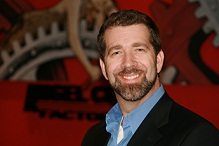
Chris Cowan of Angel City Factory.
Scott Manville and the TV Writers Vault bring us
this exclusive interview, as Cowan reveals his
process of creating Reality-based TV with an
unparalleled "high-risk, high-reward" approach, and
a priority on storytelling. Cowan, along with his
Producing partner at Angel City Factory Jean-Michel
Michenaud, is a multiple award-winning Executive
Producer and the former principal of Rocket Science
Laboratories ("Temptation Island", "Joe
Millionaire"). He most recently delivered the hit
reality TV sensation, "Mobbed" for Fox, immediately
winning an 8-episode series order from the Net.
This, on the heels of producing the inspiring
do-good/feel-good series,
“Secret
Millionaire”, also for FOX.
Other recent productions include the high stakes
game show “Duel” for ABC, the final season of
“Trading Spouses” (after a successful 66 episode
run), and the new network reality series “When Women
Rule the World”. Cowan has been responsible for some
of network TV's hottest unscripted programming. His
credits include three of television’s most
successful reality creations: the hit relationship
series “Temptation Island”, the reality comedy “My
Big Fat Obnoxious Fianc�”, and the ratings
juggernaut “Joe Millionaire”, the finale of which
was seen by over 40 million viewers, ranking it as
the third most watched episode of television for the
decade.
Having produced hundreds of hours of network
television over the past decade, Cowan is regarded
within the Industry as the Producer who took reality
TV to the next level. We're pleased to share an
exclusive conversation with him at the TV Writers
Vault and venture inside the mind of this truly
inspired Producer.
Scott Manville: Chris, thanks
for sharing your time with us. First- I watched the
premiere of "Mobbed" on Fox and absolutely loved it.
And from what I understand, Congratulations are in
order as it was just picked up for series (Airing
Wednesday, Nov. 23, 2011 at 9/8 Central on FOX).
Chris Cowan: Thanks. It was exciting and chaotic.
It’s a rare occasion that a special airs and then
gets an eight-episode order the next morning. We
delight in these moments.
SM: How were you not terrified by all of the
orchestration involved in pulling this off.... A
Flash Mob, plus their family's involvement, and more
than a thousand people learning the choreography,
AND acting in parts, leading to one moment at a
restaurant that may or may not go well, all for ONE
TAKE!? My own Wife can derail our date just by
finding out they changed the menu at the restaurant
I had planned. You really take "risk versus reward"
to a new level.
CC: We don’t know any better! We’ve made a business
out of producing high-risk, high-reward shows,
whether it’s Joe Millionaire, which has the entire
investment of a 10-episode series riding on us
keeping a secret from 90% of the cast or My Big Fat
Obnoxious Fiance, which was a massive contruct built
on deception. With Mobbed, we only need to pull off
the secret for a night versus what we’ve done in the
past which is maintaining these deceptions for well
over 30 and 40 days at a time. While it’s daunting
when you look at it, our history lends itself well
to this type of construct.
SM: I've always felt movies are great fodder for
conceptualizing projects for reality television.
When I look at the concept and format of "Mobbed",
and the story that you've cleverly orchestrated out
of that one moment or event, I see that you're
essentially producing what would unfold as any
exhilarating and beautiful ending would for a great
romantic comedy film. Will there always be a happy
ending as the series continues? What do you look for
in potential "Mobbed" moments?
CC: Basic storytelling has to rule the day in
anything you do. You must identify your hero and
what the stakes are for that hero and the other
characters in his or her life, so that while it is a
big pageant-like, massive kind of musical
orchestrated to deliver a message, in the end it all
comes down to, “What's the story of your main
character and what are the stakes in that story for
that main character?” That’s what we always focus on
regardless of the size and scale of the production.
If you’ve got a good story, you are only augmenting
it with the size or scale of your production. No
matter what, pageantry can never replace a thin
storyline. Are they all going to be happy endings?
You hope so, and I think that we feel better when
they’re happy endings, but what makes Mobbed great
is not knowing the outcome. If there’s no risk in
the fact that the show can go sideways on you, then
I don’t think you’ll feel as invested in the happy
ending. If its a slam dunk every single time, then
you’re just watching for the sake of reaction or the
scale of reaction. The potential is always there for
a very happy ending but if an alternatively bad
ending isn’t a possibility, the show is not going to
be interesting.
SM: If we look at the slate of hit shows you've
produced, there's a terrific variety of stories and
stunts. But at the core they all seem to be
outrageous social experiments. Is that your initial
approach to any concept, and producing for reality
tv? Playing with real life?
CC: Yes. Finding an extraordinary adventure in
real-life circumstance is something that we have
always been drawn to, and we believe wholeheartedly
that the independent and normal existence of people
is extraordinary and important. Regular people have
powerful stories, so we look for those kernels of
things that we share in our daily lives, whether it
be love of family, searching for romance or
answering the question of who’s the right partner
for you in life. These are all universal truths that
the audience lives and we seek to tell those stories
in extraordinary ways. Reality TV often captures
extraordinary people doing ordinary things which is
why the celebrity programming fascinates people, or
it takes ordinary people and puts them in
extraordinary circumstances living a grand
adventure. For us, the real joy is finding great
stories in normal everyday life.
SM: Chris, I've followed your career from my days at
Griffin Ent., admiring Rocket Science Labs and Mike
Darnell of Fox, as you really broke ground for all
Producers conceptualizing for reality TV- AND for
what viewers would experience. Is it more difficult
now to be "original" and groundbreaking?
CC: Without a doubt it’s more difficult now. At FOX,
ABC, CBS and NBC, there’s real stratification in the
channel line and the networks have been forced to
become even broader in their appeal in order to hold
onto their audience share, while the cable universe
has become more targeted, so there’s a channel for
every segment of the audience. Ten years ago, the
networks could play in a riskier area. Couple broad
audience appeal at the networks with the economic
downturn and there’s no appetite for risky
adventures, which is why you see the broad
entertainment-based programming and the legacy shows
working.
There aren’t many big new concepts that have worked.
I just got back from MIP and didn’t see that much
that’s new in the reality format space. Plus,
there’s so much more competition. There are so many
players in this market, and there’s been a
consolidation of intellectual property owners on the
international side with the Banijays, the Fremantles
and the Shine Groups of the world. You also have the
maturation of the genre. There was a moment in time
when almost every good concept in the reality space
was being sampled, but now our genre has matured to
the same level as scripted. Today, we are held to
the same standard as comedies and dramas not only in
the originality of the concept but also in how well
it is produced.
SM: What do you see as being the biggest impact,
good or bad, Reality TV has had on the Industry?
CC: Reality is nothing new. We just have a new term
for it. Reality is the oldest genre, dating back to
variety shows that helped television get started.
Today we call American Idol a reality show format,
but it’s really an old-time singing competition.
Ultimately there’s nothing new in reality other than
its packaging, but it has allowed for a
diversification and broadening of the number of
channels that can provide original content because
reality can be done cost effectively and with less
production. This has helped the cable universe
become extremely successful and gain audience share
on an annual basis. I would say that’s probably
reality’s biggest impact—allowing for a broad
spectrum of channel line ups that tell a
multiplicity of stories.
SM: And for viewers?
CC: It’s diversity again. I think reality pushes
dramas to be great. I think the unscripted genre
makes the scripted television better. They feed each
other. Overall it creates a healthier entertainment
industry.
SM: Can you share with us the current focus of Angel
City Factory, with regard to producing? Is there a
specific mandate?
CC: Angel City Factory’s ultimate mandate is to
generate new formats and intellectual property for
the world market and to feed into our parent company
Banijay’s distribution chain. The US is an
incredibly important market around the world, and we
have had a long track record of creating original
ideas. We want to continue to create, develop and
produce original formats that we can feed into the
international market because I believe there’s a
need for even more new and interesting ideas.
SM: Where do you see the future of reality
television heading with regard to content?
CC: The democratization of the genre is what’s
really interesting and important, and the genre will
continue to be as adventurous as the buyers allow.
There’s no doubt there are a thousand producers with
a crazy glint in their eye doing something really
wacky and looking for a broadcaster to air it. While
it’s been safer on the broadcast level where all of
the dollars are, I hope we get back to more
adventure. On the cable level, you’re going to
continue to see a crazy diversity of unscripted
ideas and people finding new ways to tell stories. I
think that’s really healthy. You’ll continue to see
the broad diversity of cable channels play out for a
while and then sooner or later, there will be
consolidation. I don’t think you can have five
different networks targeting the same age bracket of
women with the same economic makeup, but right now,
I think it’s fantastic.
SM: Within reality TV, you have a whole slate of
sub-genres (docu-style, elimination/competition,
hidden-camera, relationship, etc.). What is your
favorite niche to produce, and why?
CC: Anything that has a long arc. I love reality
competition arcs and I love relationship arcs.
Something that allows you to follow a set group of
characters over a long period of time. Something
that shows growth. Something that shows the
evolution of stories. That to me is by far the sweet
spot of the reality genre.
SM: Let me take you back a bit. How did you get your
start in this Industry, and what led to developing
and producing reality television?
CC: I started producing film shorts when I was in
high school. I ended up going to film school at Ohio
University and was intoxicated with the medium of
film. I loved shooting my own stuff and writing.
Then I moved to Hollywood without knowing hardly
anyone. I think I had one contact in the industry
given to me by one of my sound professors. When I
landed in Los Angeles, about four weeks into my
residency, I ended up getting a job as a P.A. for
$35 a day at a small production company. I bought
that production company and turned it into Rocket
Science Laboratories.
It was great because we were doing behind-the-scene
documentaries, and I was lucky enough to do them for
Amblin Entertainment, Steven Spielberg’s company. To
me, it was like an extension of film school—to be on
a film set and watch the best directors in the world
craft movies and then I got to tell the story of
them making their movies. I couldn’t have had a
better education in storytelling.
SM: What advice can you give to some of the Writers
and Producers at the TV Writers Vault breaking into
the industry? Many have option deals, but just can't
get that one project to go the distance for
production.
CC: First, be as literate as you humanly and
possibly can, because the ability to articulate an
idea is as important as anything in the business.
Hone your skills and really pay attention to your
ability to articulate an idea in an energetic,
interesting, and smart way. Secondly, don’t always
listen. You need to take all of the advice that you
get on your ideas with a grain of salt because
ultimately everyone’s going to have an idea and an
opinion. If you believe in your ideas, you have to
stick with them because passion and skill will rule
at the end of the day.
There are so many people who believe they know
what’s best, but they’re all at best opinions. There
is no right answer. If there was a formula for
making a hit TV show, there’d be more hit TV shows.
You’ll walk into a thousand offices for a thousand
pitches and they’ll all be absolutely convinced they
know exactly what their audience wants.
SM: When you're producing, do you focus on any one
area of Producing more than another? What is your
favorite task in the process of producing, from
conceptualizing to editing?
CC: I don’t focus on any one task. I do stick very,
very heavily to the creative side—anything that
deals with the creation and the creative management
of a property rather than the means of production.
My interest is really in the story outcomes and the
creative side, from casting to the shoot day to the
edit bay.
SM: Is Hollywood a collaborative community driven by
“idea”, or an insulated machine driven by formula?
CC: That’s a tough question, and there is no right
answer to that. It’s both. The measure of the
Hollywood experience is the quality of the executive
that you deal with. Good executives put you into a
collaborative process, bad executives operate from
fear-based positions and follow formulas.
SM: With the rise of New Media, is this an area that
drives you when producing new projects? Or is it
just a great ancillary benefit after a show is a
hit?
CC: Don’t let new media dictate what we’re looking
to do. There are so many outlets. There are so many
ancillary revenue streams. I focus on storytelling
and the hour of television that we are producing.
And then I let somebody else worry about all the
other ways to take advantage of new media. Out of
success is generally where the new media models are
born.
SM: Beyond your own talent as a Producer, what does
Angel City Factory bring to the industry that some
other companies don't?
CC: You build the business culture that you’re in
and you look at your competitor’s material and you
admire their skill set, but you don’t really know
how they get their jobs done. Honestly, I don’t know
how other companies work. We try to identify
ourselves by our skill as producers and ultimately
our model is based on what we hope is superior
creativity. In the end, we want to give an idea the
best chance to survive in a very difficult market.
SM: If we look at your talent for producing, what
single thing has given you an edge in finding
success above others in this highly competitive
industry?
CC: I’ll say humility.